

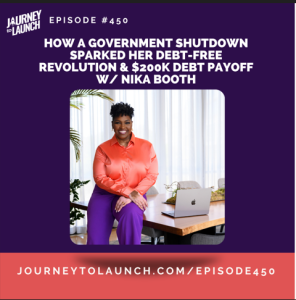
In this powerful and transparent episode of Journey to Launch, I sit down with Nika Booth, award-winning financial coach, content creator, and founder of Debt Free Gonna Be, to unpack how she paid off more than $200,000 in debt while refusing to sacrifice joy along the way.
From student loans and credit card balances to IRS debt and government furloughs, Nika shares the raw truth behind her financial journey, the highs, the setbacks, and the emotional lessons that reshaped her mindset about money, self-worth, and freedom.
She opens up about her early money mistakes, growing up in a household where finances weren’t discussed, and how the 2019 federal shutdown became the wake-up call that sparked her debt-free mission. Nika also reveals what it really felt like to finally see her student loan balance hit $0, and how she’s now helping others find hope, healing, and fun in their own money journeys.
In This Episode, You’ll Learn:
- How Nika Booth paid off over $200K in debt from credit cards to student loans, without sacrificing fun or joy
- The pivotal 2019 federal shutdown that sparked her debt-free journey and reshaped her money mindset
- What it really felt like to finally see her student loan balance hit $0 through Public Service Loan Forgiveness
- How she turned Debt Free Gonna Be from a personal goal into a thriving community helping thousands manage money with confidence
Check out the video to this episode below or on YouTube here.
Connect with Nika:
- Website: DebtFreeGonnaBe.com
- Instagram: @DebtFreeGonnaBe
- Twitter: @DebtFreeGonnaBe
- Facebook: @DebtFreeGonnaBe
Connect with me:
- Instagram: @Journeytolaunch
- Twitter: @JourneyToLaunch
- Facebook: @Journey To Launch
- Join the Private Facebook Group
- Join the Waitlist for My FI Course
- Get The Free Jumpstart Guide
Nika Booth 0:02
There's a lot going on with student loans right now, and the best way to make a decision about whether you stay or you go and pursue something else and maybe abandon the idea of forgiveness, is to stay aware and up to date on what's going on. That's key knowledge is power, right? So you've got to know exactly what's going on, to know what your options are.
Intro 0:23
10 seconds, welcome to the journey. To launch podcast with your host Jamila Souffrant as a money expert who walks her talk she helps brave journeyers like you get out of debt, save, invest and build real wealth. Join her on the journey to launch to financial freedom in 54321,
Jamila Souffrant 0:51
if you want the episode show notes for this episode, go to journey to launch comm or click the description of wherever you're listening to This episode in the show notes, you'll get the transcribed version of the conversation, the links that we mentioned, and so much more. Also, whether you are an OG journey or brand new to the podcast, I've created a free jumpstart guide to help you on your financial freedom journey. It includes the top episodes to listen to, stages to go through to reach financial freedom, resources and so much more you can go to journey to launch.com/jumpstart
Jamila Souffrant 1:27
to get your guide right now. Okay, let's hop into the episode. Hey, journeyers, welcome to the journey to launch Podcast. Today. We have a special guest Nika booth. She is an award winning financial coach, content creator and founder of debt free. Gonna be by the way, I just I love your name. I love the brand name. What began as her personal journey to pay off more than $200,000 of debt has grown into a nationally recognized platform helping 1000s take control of their money and pay off debt without sacrificing fun. This interview has been long overdue, so I'm really excited to have Nika on the podcast so we can learn more about her journey and inspire you as journeyers listening to welcome Nika. Thank you,
Nika Booth 2:13
Jamila, I'm so excited to be here. You're right. It's been a long time coming.
Jamila Souffrant 2:18
No, but you know all things when they're supposed to happen. That's how I feel about life and the journey that we're all on. So I do want to take it back a bit about your origin story. I know your whole goal, like it's starting, was to pay off debt, but take me back to before that. Like, when did you start to get into debt? Like, what is your kind of origin story, your villain story? Yeah.
Nika Booth 2:40
So, like many people, I, you know, not blaming my family, but I grew up in a family that didn't really talk about money. Whenever we talked about it, it was, like, always in a negative light, like, what we don't have, you know, you asked, I asked my mom. And I was raised by a single mom, but I would ask her, you know, can we go to McDonald's? And it would be, do you have McDonald's money, you know? And so it was just always centered around lack and so when I, you know, got into a little bit of money from working, you know, while I was in high school or college, or even when I got my first credit card, you know, I didn't have the education that I have now and how to successfully manage that type of stuff, especially when it came to credit, and so I probably started getting into debt my freshman year of college. That's when I got my first credit card. That's when a lot of people end up getting their first credit card. I signed up for maybe a t shirt or a bag or something capital one happened to be on campus at the time, and I'm like, Yes, I'm going to get my first credit card for emergencies only? Well, again, I didn't have the discipline or the education that I have now, and so that for emergencies only ended up being Walmart runs whatever me and my little friends were doing. You know, I might have put textbooks on there at one point in time, but, yeah, I definitely didn't use it for emergencies, and it kind of just snowballed from there. And so it went to that freshman year of college. I don't know where we got the money from, but I had just enough money to, like, pay for, like, my courses for that semester. And then after that, that's when the student loans started coming, because we realized it, and so the money might have come from, like, gifts from graduation or something like that. So student loan scheme, and also, like many people, I didn't read that promissory note. I didn't know exactly what I was signing up for. I just knew I wanted to go to school. My peers were going to school. My guidance counselor told me to go to school. You know, my family was saying, hey, you know you're going to be the first person in the family to go to college. You know, we're rooting for you. But nobody had money to send me to school, and so I started racking up student loans, and I was taking the max amount every semester, again, because I didn't really have a. Plan. I just knew I had to pay for school. Didn't have a job, and so I'm like, Okay, I'm gonna get this refund check. And the refund check is really the thing that kind of caught me up, you know, not understanding at the time. And some people may say, Well, what do you mean? You borrowed the money? Didn't you know you needed to pay it back? Well, when you're 1819, years old, and you don't really, you're not really thinking that far ahead in the future. You know? You're not thinking, Oh, I've got to pay this back. How am I going to you assumed everything in life is going to go according the way you plan it, right? And it's going to go your way. But one of the lessons I learned is that that's not how life works. Life isn't linear, right? And so, you know, throughout undergraduate and graduate school, I accumulated loans, although I was working, but I accumulated roughly around 80, $90,000 in student loan debt across undergrad and graduate school, and also along the way, I gained more credit card debt, and so I had amassed roughly $90,000 in student loan debt, but I was working and I knew I made decent money like so we're fast forwarding a little bit. You know, I've accumulated more credit card debt because my credit wasn't bad. You know, that is one of the misconceptions about people who are in credit card debt, is that they have poor credit. And that's not, that's not necessarily true. And so, you know, when people say, Well, how did you keep getting a credit card? Well, they kept giving me a credit card. What do you mean? Or they kept, they kept increasing my credit limit, like, you know. And so I had come across Dave Ramsey, and it was listening to him that kind of made me realize, you know, this tug and pull that you have with your paycheck and the people that you owe. It's like, every time you get paid, you owe somebody, and you don't really have a whole lot of your money left over when it's all said and done. I was broke. I was a high earner. At least I thought I was a high earner, but I never really had money for the things that I wanted to do or or I would use the money for the things I wanted to do without making progress towards other things like retirement contribution or paying down the debt somehow or another. I came across Dave Ramsey, like I had done, like a Google search about paying off debt, or like steps to take to pay off debt. And I said, All right, I'm gonna try this. But one of the things about his teachings is that it promotes deprivation. It promotes or depravity. I don't know what the real word is. Like. I may have that wrong, but like it promotes you basically stretching yourself, not living, eating beans and rice, literally or figuratively, whatever. But it talks about you needing to make these huge life sacrifices in order to get out of debt. Now, that may be true, but I know that wasn't going to work for me. And I tried it, right? I tried paying off debt, and I wasn't doing anything. I wasn't going out. I wasn't eating out. I was just like, I'm going to focus on this. But I was miserable. I was in six figure debt, across student loans and across credit card debt, and I still had some some on my like, $5,000 left on my car loan, and I was miserable, and I'm thinking to myself, I'm tackling this mountain of debt by myself. There's no way in the world I'm not going to live while I'm doing this. Like it just there. It's for some people. It wasn't for me. And so I said, All right, if I'm going to do this, I'm going to have to do it my way. So I started, officially starting my debt payoff journey in September or October of 2018 now this is a very interesting story, Jamila. And I said, All right, I've tried to do this before, and I failed at it. This is what I'm going to do moving forward. I start with my smallest debt, like the snowball method, you know the method. I'm start with my smallest debt. But what I'm going to do when I do my budget, I'm going to make sure I still budget for fun. I'm going to I'm a huge baseball fan. So I'm a fan of the Washington Nationals. They were the 2019 World Series champions. And so I said, All right, I'm going to keep going to the baseball games. I'm just going to buy the cheaper tickets. I'm going to keep getting my nails done, but maybe I spread out the frequency, right? So it's not every two weeks. I'm getting a fill in. Maybe I'm extending it a little longer, or I'm going out with my friends, but it's going to be happy hour at the end of the day. I was still going to live. I was not going to sacrifice fun, which is how that became part of my my my tagline, right? But I'm also a federal government employee, and the government shut down just a couple of months after I started my debt payoff journey, and that shutdown lasted 35 days. During that 35 days, I actually worked full time, but received a partial paycheck, so there was no way to predict how much my check was going to be. It. The uncertainty at the time, because the administration had been very vocal about their thoughts on the federal workforce, and so we didn't know how long it was going to go on for. The longer it went on for, I'm thinking, Am I going to be able to pay my mortgage because I do have a condo? Am I going to be able to put food in the refrigerator? You know? Am I going to be able to feed myself. Am I going to have to sell and go move somewhere else? And I also thought that this shutdown happening just a few months or a couple months after I started my journey for real this time was this the universe's way of telling me, No girl, you're not going to ever pay this debt off. You're going to be like other people in debt, and you're going to be in debt until you die, especially with over $100,000 in student loan debt. And so real quick, when I started my journey, I was about $189,000 in debt. So that was about 120 130 in student loans. That was 50,000 in credit card debt, and that was across 15 credit cards. Don't judge me, but that was across 15 credit cards, and the remainder was what I had left on my car loan. And so I thought this, this furlough was a sign this, this government shutdown, was a sign that you're just going to be in debt for the rest of your life. But those 35 days passed by and Congress said, Okay, y'all can get y'all back pay. So got my back pay. But I'm telling you, the amount of uncertainty around me, not knowing whether I would be able to provide for myself, and having someone else be that much in control of my ability to provide for myself was the catalyst to me starting, like, restarting my debt payoff journey and sticking to it. Because what do you mean? At this big age, somebody else is saying, Oh, we're going to pay you, or we're not going to pay you, or we're going to pay you, but we're going to pay you half your paycheck. Absolutely not. And so after that shutdown ended, that was a that was around July 2019,
Nika Booth 12:07
I said, well, for an extra layer of accountability, I'm going to start putting this out on social media, and I'm going to create an Instagram page, and this is where I'm going to document my journey, because the main person who will hold you accountable and has opinion about what you do with your money is a stranger, especially a stranger on the internet. And you know this, people are very opinionated. So I started debt free gonna be. And I came about that name because I had found the hashtag debt free community, and I was looking at to see what other people were doing, and I was like, Okay, there's a community of people that are also paying off debt. And my biggest gripe about it was, no one looked like me. No one was a woman who was a woman of color, a black woman who carried six figure debt and was paying that off by themselves, at least that I have found. And so I said, All right, well, that's one thing. So I see I might be out here by myself, and you know, it's really brave of you to want to put your business out there on Front Street, as they say, you know, on the internet. But I had also started coming around people wanting, like, saying I'm a debt free wannabe. And I'm like, Nah, I'm not a debt free wannabe. I didn't came out. I rose out of the ashes of this government shutdown. I'm gonna get out of this debt. And so I said, Well, I'm a, I'm not a debt free wannabe. I'm a debt free gonna be right? Because I'm gonna be debt free now that name has evolved where it's no longer me, like I'm not necessarily synonymous with it. It because it became a community. So I started sharing when I got paid and what debt I was going to pay off. And I showed screenshots of the balances going down and everything. And I want to say, By the summer of 2019 I paid off like around $15,000 most of it was credit card debt, but I did pay off my car too, but I was having this internal conflict Jamila, because I knew I still had outstanding tax returns for two years, if I recall that it was 2017 and 2018 tax returns for both state and federal. And I said, Mika, if, if you're serious about this, you're already, you know, you've got this momentum, your your community is growing like you. People were following me like people started to cheer me on and say, Oh, I'm paying off debt too. And I'm like, Oh, well, I didn't expect this. But this is cool that I don't have to do this by myself, but I was making progress. And I said, All right, if you're serious about this and you want to be transparent and you want to be able to continue to show up as your authentic self, which was important for me, with this platform, you got to come face to face. Of these tax returns, and I knew I owed which was also why I delayed in filing them. But I said, All right, you got to hire yourself a tax professional, get these returns submitted and just deal with it.
Jamila Souffrant 15:12
So these were from not filing taxes for two years.
Nika Booth 15:16
These were for not filing taxes, yeah, for 2017 and 2018 which meant not only did I have the tax liability, but I also had whatever penalty and interest. And so I got a tax professional, and I don't think I really grasped how much money I had not paid. So let me also just quick back story. In this back story, I had a co worker that told me or showed me that you can adjust your withholding again. I did not have the education that I have now, but I had a co worker that showed me how you can adjust your withholding to get extra money on your paycheck. And what I did was, I think I put my withholding at like 10. Mind you, it's just me. I don't have no children, no nothing, no dependents, right? Nothing, okay, yeah, completely uneducated, okay. Screwed myself big time, because the part about this that she told me, but I didn't listen to was that you don't keep it that way. You maybe do it for a few months, so you know you're even out at the end of the tax year or something, or that you don't owe Uncle Sam at the end of it. Well, that's not what I did, Jamila, I kept that going for at least two years, okay, at least getting this extra money, which wasn't really mine, because I owed it to the government because of the wages that I made. So that's why I delayed filing the outstanding tax returns, okay? Or those outstanding tax returns, because I knew I would owe because I did something stupid. So we filed the tax returns, and I am waiting, waiting for the bills to come in. Those tax bills come in. Now again, I started what I promoted right? Because it was my student loans, my credit card debt and my car loan. $189,000 let's say I paid 15,000 I think that's what I paid by this time those tax bills came in and they totaled $21,946 I have since then forgotten the cents, but at one point in time, I could rattle off that number down to the penny to you, because that's how impactful it was. Because not only was it more debt, but it put me over my starting balance. So here I am $200,000 in debt at this point. So I was devastated. I was conflicted. Do I share this? Are people going to think I'm a failure? Because so far, everything that I had put out there was me consistently and progressively paying off this debt. Well, here I am having to go backwards because I've accumulated more debt, and so I'm thinking they're going to think I'm a fraud. No one's going to follow me. I'm going to get canceled. I've got a decision to make. I want to say I ended up dealing with a little depression, but I and I confided in my therapist and confided in a friend who was like, you know, no, you got to put it out there. You've put everything else out there. You tell the people. And so I made a post. I mean, I was devastated, Jamila, I thought I was gonna quit. I was like, This is yet another sign, girl, you're not getting out of this debt. But I created a post, and I can't remember if I'm crying in this post, because again, I shared the good, bad and the ugly up until that point, but I remember posting about it, and people were thanking me for being honest and for being transparent, or also saying, Oh, I owe the IRS too, or I owe my state too, you know? And so I'm thinking, Oh, well, this didn't go the way I thought. You know, it's all things are always worse. I don't know. I don't know if you're like this, but you think things may be worse in your mind, but like, they don't work out that way at all. No, I totally This is, first of all, thank you for sharing that. I'm pretty sure maybe I saw that about your story years ago, but maybe forgot that was part of the fabric of what makes you you. But I think being vulnerable like that is so like, you think, like, oh my gosh, that's gonna be something people judge me for, but so many people can relate to making those mistakes or appreciate like, Finally, someone is telling the truth about the mistakes they're making, because so many other people are making those mistakes. But Nika, I want to go back a bit, because, first
Jamila Souffrant 19:48
of all, thank you, because you didn't, you did most of my work for me. For the first part, I love it. No, no, this is good. I love look, you actually answered a lot of my questions. But I want, I want to. Want to go back, because there's some things that I think will be helpful for the audience to learn about you, or just for me to understand more about you. So what was your degree in?
Nika Booth 20:09
Okay, so my undergraduate degree is a dual degree. It's in biology and chemistry, and then my my master's is in biotechnology with a concentration in regulatory affairs. It sounds real.
Jamila Souffrant 20:28
Okay, all right, so what did you think that you were going to do with those degrees? Like, what was your goal? Career goals? Oh, I
Nika Booth 20:35
was. I planned on becoming a doctor. I actually thought I was going to be and I held on to this dream for a while. I thought I was going to be a pediatric oncologist. This was, this was before I acquired my master's degree. I thought it was going to be a pediatric oncology oncologist. And I said, Girl, you too sensitive to deal with kids that got cancer like you. That's not it sounds good, but you're not gonna be able to do that. But it wasn't until I had actually entered in to the biotechnology industry, the biotech industry, I'm a science girl. Through and through that I like, was like, Oh, this is it. This is where I want to be. And that's what made me then go forward to get a master's in biotechnology. But from the regulatory side, because I knew I would probably want to be a regulator. I've always been interested in, like, regulations and law and policy, but, yeah, no, I'm not a doctor. So with that, so the amount of student loans that you took out, or would that have changed? Maybe where you went to school, or how you did things outside of taking out too many loans for when you at the time? Oh, yeah, absolutely. So one my freshman year of college actually went to Hampton University, an out of state, private institution. So that was the other thing, you know. I didn't stay. You know, most people know that if you stay in state, tuition is less expensive, especially if you go to a public institution. But now not me. I wanted to go to the other Hu and so, you know, and again, no one had any money to send me there. So there's that, but yeah, had I, had I made? Had I had taken the time to do more research? Had I not been and, you know, and it's not on no one but me, but had I not really given in to peer pressure, because I thought I had to keep up with the people that I was going to school with and graduating with? Had I not given in to, like, familial pressure, like being the first, not just the first person, to go to college, I'm the first college graduate in my family. You know, had I not given into those things, I probably would have gone to different schools and would have been in less student loan debt.
Jamila Souffrant 22:47
Yeah, but see, and I think, though, sometimes, you know, you go through those experiences, someone maybe right now they're in school, or they had that where they thought they were going to do this, and they're doing something totally different, but you have to go through it to see what the next step is for you. And it seems like you transitioned well into something else. And so with that, I love that. You know, currently, as we are recording this, we're recording this in the week of October. It was October 22 this will probably come out next week 2025 we're in the middle of a federal shutdown. But you talked about the federal shutdown that happened when you declared your that you are going to start your Debt Free Journey. I want to kind of go back there, because I think from the outside looking in for, like, federal jobs at one point, like, oh, it's safe for the most part, right? And guaranteed money. But you, you have experienced this before, and this uncertainty with income and having to deal so as you came out of that shutdown, as you've gone through other things in your life up until now, what was it more important than to build an emergency fund, or what was what, what changed or shifted in the way you saw money and your job and security as you went on your journey?
Nika Booth 23:57
Yeah, yeah. Just, I want to, I definitely want to, like, piggyback off of that, that at one point in time, working for the government was the secure thing, you know, get yourself a good government job. You know, you'll have a job for the rest of your life. And that, that furlough, this furlough, you know, this shutdown, is showing me something completely different. But, yeah, it was the emergency fund. Because one of the things, and thank you for that, because there's obviously some some pieces missing there. But yeah, I had exactly $1,000 maybe $1,500 in my emergency fund, listening to, you know, the Dave Ramsey teachings, and it $1,500 is something, and it is more than a lot of other people have. But it's not enough when you are living paycheck to paycheck and shackled in debt. It's not so. One of the things I learned during those 35 days, and as I continued to pay off debt coming out of that shutdown, was you need more money. And so what I did was, as I paid off debt, I was also still saving. You know, some people. Some people have the luxury of being able to save first, then pay down debt, or pay down debt and then save. But again, I was doing this by myself. I had financial obligations on top of the mountain of debt that I had, and so any missed paycheck, any illness, it's all on me. And so I didn't have the luxury of only doing one at a time. And so I would consistently contribute to, I think I started off with like, $100 every time I got paid. And then, you know, as I paid off more debt and I had more cash flow, I would, yes, increase my debt payments, but I would also take a piece of that and increase my emergency fund as well. And so, you know, as we're talking about, yeah, here we are at this time, 22 days into this government shutdown, my financial landscape looks a lot different. I have all I have almost five months of my income or my expenses saved up, as opposed to $1,500 which helped me. I'm not knocking at $1,500 when I needed a little bit of it. It was there to help me, because I was getting paid, you know, not a full paycheck. So I'm not knocking that at all. But yes, I think it's very important whether you work for the government or not, like the best thing you can do in in securing up your financial footprint, or your financial outlook, is pay down your debt and have emergency savings, because it's not a matter of if, but definitely a matter of when. So yeah, my emergency fund was definitely a huge part, not only then, but definitely now, as we're navigating this one right.
Jamila Souffrant 26:36
And I just know for a lot of people who are still in debt, that's the question that comes up, like, what do I do first? Do I do it at the same time? But if you have nothing saved, no emergency fund, whether it's like a starter 115 100 or, you know, maybe two to three months, you need to, even if it takes you a little bit a slower start for you to pay off debt, and you have to put less towards the additional debt payments. Do that so you can least have a safety net in case of something happening exactly because,
Nika Booth 27:02
if not, if you don't have that safety net, you're just increasing the likelihood of going into more debt, right? Because if you don't have that money set off to the side, you're probably going to have to, I mean, unless you have family that you can, you know, borrow money from. But even still, that it's kind of debt if you're borrowing it, right? But, yeah, you increase your likelihood of going into debt because most people have to swipe a credit card, unfortunately.
Speaker 1 27:25
Hey, journeyers, if you are loving this podcast, then you will love my book, Your journey to financial freedom, a step by step guide to achieving wealth and happiness. I wrote this book for you. This book is for you. If you want a clear and enjoyable path to having more money, options and a rich life, this book is for you. If you hate your commute and the fact that you need to seek approval or permission from a boss, I hated that when I worked. This book is for you. If you weren't born into wealth, you didn't marry rich or won the lottery, but you still want freedom. This book is for you. If you're at a crossroads, a major decision or event is imminent, maybe a career change, marriage, starting a family, pressures are reaching a tipping point, and the discomfort and the desire for more can no longer be ignored, and this book is for you. If you find yourself zoned out at meetings, looking out the window or daydreaming about the life you truly want. So go pick up your journey to financial freedom.com. So I can show you how to map out how to get from where you are today to where you ultimately want to be. And enjoy the journey. While you're on the path, head over to your journey to financial freedom.com. To see where you can pick the book up. It's available on Amazon bookshop.org, Barnes and Noble, your local bookstore everywhere go to your journey to financial freedom.com. To get the book now.
Jamila Souffrant 28:53
Can you talk about so I read your bio on your website, and it talked about you feeling, not necessarily, like, super passionate about what you were doing, but you were on the debt, I think, forgiveness program. Oh yes, yes, yeah. Can you talk about that? Because I don't. I know there are some people who are have qualifying jobs where they are staying in just because of that, just so they get their loans forgiven. And I know the landscape has changed. I've been talking about this. I'm no expert in it. You know, you have a lot more information about, like, what qualifies and sending in information to get your student loans forgiven, but talk about that, like, that trade off of staying in a job that you don't love, but you know, if you stick with it, you get your forgiven, versus not doing that and going somewhere else, maybe making them new or being
Nika Booth 29:42
happier. Yeah, and I definitely, and I have obviously a personal story to that too. So the Public Service Loan Forgiveness Program is a student loan forgiveness program for people who basically dedicate a minimum of 10 years to a nonprofit organization or a government organization, whether it be low. Local, state, federal, any tribal organization, and at the end of that 10 year repayment period, your student loans, including any interest that has accrued, gets forgiven. Now, when I was going through my debt payoff journey, that program had an approval rating of like 2% there were people who qualified for this forgiveness, but they were not being granted the forgiveness. There was a lot of red tape put up by the Trump administration at that time, and actually now as well, that were preventing people from getting approved for this forgiveness. And as such, that was also one of the things that made me say, Okay, I've got to get rid of this overhead. I've got to get rid of this debt, so let me just start tackling my credit card debt first, and my car loan, and then get to my student loan. So I had every intention of paying off my student loans because the program was not working the way that it should have been working. I've been in the federal government for 16 years now, and only recently got my student loans forgiven a couple of years ago, but saying all that to say, Yeah, I was, I was torn because I had six figure student loan debt. I didn't have $100,000 and have $130,000 to throw at it myself. And every month I would see my balance grow, even if I was making the minimum payment, and I kept holding on to the job, one because it was a good government job, but also because of the promise of student loan forgiveness at the end of it. And it's really tough because, like I said, and thank you for reading that, I wasn't passionate about what I was doing at the time or anymore. It had kind of like the novelty had worn off. I was good at it, but there's a difference between what you're good at and what there can be a difference between what you're good at and what you're passionate about. And I was no longer passionate about it, but it was what I was good at doing. I became an expert in that area. And so there was always this conflict, because it's like, well, girl, you don't have that money, so you might as well just stay at your job, and it's a paycheck. There's this pull on you when you are having to show up every day to do something that you're not passionate about because it has a string attached. But again, the program was supposed to work, and it eventually did. It eventually did. The Biden administration came in and did some temporary fixes to help more people qualify for it, because they should have qualified for it in the past, and that's actually how I got my loans forgiven. Thank goodness. You know I was able to take advantage of that.
Jamila Souffrant 32:27
So how did you grapple with staying did you stay in that same position and job, or did you transfer? I
Nika Booth 32:33
did not stay in the same position. Thank you. I did not stay in the same position, but I stayed at the same agency. I ended up getting promoted with a different office, but I'm still tied, but I was still tied to public service, because that's the other challenge. I actually love serving people. My grandmother was my, my role model, and she was a nurse. Everyone in the community knew her, and she always showed up for people. She was always willing to help people. And I, although it was, wasn't my passion, but it was what I was good at. There was some type of reward. It didn't happen all the time, because it's a thankless job when you're when you're a civil servant, because the American people don't really know what the government does, other than what rhetoric may be out there about them, but we show up and we get paid less, but we show up every day to support and provide service to the US public, but anyway. But yes, so I did. I did end up getting promoted in a different office, so I stayed with the same agency, and I'm actually still there now, but I've been promoted again. I've been promoted again. So I've moved around to kind of help with breaking up, I guess that monotony and kind of like, like, spark that enthusiasm again, in in in my life, or in my, in my, my career,
Jamila Souffrant 33:48
right? Well, what advice do you have for someone who you know, in the context of this, we're talking about forgiveness, staying at a federal job or a nonprofit even if they're not enjoying it or something else? Maybe there's another tie or promise. So you have to choose between, do I stick here and stick it out, versus jump ship and do something else? What are the considerations or advice you'd give to someone to help make that decision?
Nika Booth 34:11
Yeah, I mean, you definitely have to, like, keep your thumb to the pulse. So, like, there's a lot going on with student loans right now, and the best way to make a decision about whether you stay or you go and pursue something else and maybe abandon the idea of forgiveness, is to stay aware and up to date on what's going on. That's key. Knowledge is power, right? So you've got to know exactly what's going on to know what your options are. The other thing is like, if you're miserable, if, if where you are is causing you stress is affecting your mental health. You know you have to decide whether staying there is causing more of that grief or that strife, or is it the money itself, or is it the debt itself, right? And so that was my thing. My thing was I wanted to pay the debt off, or I wanted to get out of. The debt. But I didn't want to have to throw I wanted the government to do what it promised to do, right? And it just so happened to work this time around. But I did not want to leave and then be 100% on the hook for paying off that debt again, because it was a lot of debt. Now, if you had 50,000 and again, it's all relative. I had $130,000 in student loan debt, if you've got 10,000 and that's manageable for you and your peace of mind in the reward you get out of out of life and where you show up, you know for a job every day is more important than do that. But if you're sitting on a mountain and you don't think that you have the capacity to pay it off yourself, then stick it out as best you can. But I will never have it. I will never say that someone should jeopardize their mental health, because once your mental health starts getting impacted, it's, it's a cycle. It is a cycle, and it can impact. It can, I guess, creep into other areas of your life as well beyond your job,
Jamila Souffrant 36:00
right, right? Well, so as you move forward now, so you got your student loans forgiven, finally, but at that point did you have? Did you pay off your other debt, or where were you with everything else? I
Nika Booth 36:12
sure did. So in I gotta make sure I get this right. Okay, so the temporary waiver was announced in 2021 from the Biden administration. I applied to it and told everybody I knew about it. That's when I was going on on Instagram, because I was trying to get everybody to apply, get out of your debt. So by 2022 I had paid off everything, the outstanding tax debt, all of my credit card debt. I still had my mortgage, but my mortgage was never a part of my debt payoff plan anyway, and all that was left was my student loans. Outside of that, towards the end of 2022, I had logged into studentaid.gov, and I saw a zero balance Jamila. And you know, it's still this emotion. I still get emotional when I think about it, or when I tell the story, because I carried that debt with me for years. I thought it was going to stay with me, until the day that I died. Not only did it stay with me, but it never went down. I only saw, I mean, my student loan payment was $847 and it still it would not go down. Month after month I would see it creep up, and if I made any progress towards the principal, it was like $1 or two. So it was never going anywhere. So it was balloon. It was going up, and it was with me. It was like the elephant in the room. Like I said, December 2022 I log in, I see a zero balance in studentaid.gov, a couple of days later, I see a zero balance with my student loan servicer. And I can't tell you the weight, the weight that was lifted off my shoulders because I was free. Yeah, I still had a mortgage, but my mortgage was under 1000 under 1000 it's manageable, right? But carrying around something for so long and then it finally being gone. But I was like, You know what? Ashton Kutcher around here somewhere, I'm probably getting pumped, so don't celebrate too soon. Let's just wait until you get something official. It took until January of 2023, for me to finally get a letter, and it said, Congratulations, you've satisfied the obligations of public service, loan forgiveness. And so I knew at that moment that not only did I not have to carry around that debt anymore, I was also free to choose a different career path if I wanted to, because I wasn't obligated to staying in public service, but I also felt relief for my mom and I didn't share this before, but my mom carried a lot of guilt for not being able to help me go to college. And so for any parent that's out there, you know, that is feeling a type of way that weren't able, you know, and they have, you know, children that are in student loan debt, like it's not on you, but I felt a tremendous amount of relief for her, because she no longer had to worry about me carrying so much debt through life anymore. And so yeah, January 2023 aside from my condo, I would you know, I didn't have that consumer debt, I didn't have the credit cards. I didn't have the tax debt. I didn't have, you know, I was free. I was able to start putting more of my money towards the things that matter to me, my retirement, other types of investing, helping other people. But I'm back in debt again. I
Jamila Souffrant 39:36
love that, yeah. Well, I want to talk. I'm gonna get there. We're gonna talk about that, but I think, but it's, it's really something to know that, especially when you like this money, money is made up, it's like, all this, like invisible, we never touch, like, the money you owed, you know, you would never have that in your possession, or the money even that we invest, right? Like, it's all. Kind of just made up invisible. We don't see it, but if we log in somewhere, then we see it, but it's such a heavy weight, it's like load or weight that we carry in the world. And so thank you for sharing that, because I just know so many people also still have a load that they're carrying, maybe avoiding, right? But it's like, just to let them know, like, that is it's real, like it's okay to have those feelings and to hopefully one day confront them, and maybe you don't have the option of student loan forgiveness, but confronting it, knowing that there's no shame in having debt, that a lot of this was constructed for us to be in debt, and to understand that there, there's still a way to get out of it and or still live a good life managing it.
Nika Booth 40:43
Yeah, absolutely. You know, I I carried shame and guilt and regret to the point Jamila. I hid it from people. I hid my debt from people for a long time. I hid it from the significant other I had at the time. But debt isn't always the result of frivolous spending. Sometimes people have to take on debt for basic necessities, just simply because, like you said, the way things are set up. And so, yeah, a lot of people can be hiding, and I hid from it. I didn't. I avoided collection calls at one point or not collection calls, but, like, past due calls and delayed opening the mail, and sometimes I wouldn't at all. But self care includes coming face to face with your numbers, because without knowing where you're starting, there's no way you can create a path to get to you know your goal of paying down your debt or paying off your debt, or whatever that case may be,
Jamila Souffrant 41:37
right? Well, tell me so now you have no debt at that time. How did it feel like did all your dreams come true right away? Because I think there's a conception or misconception that, whether it's a saving goal, investing goal, even, you know, my I talk a lot about reaching financial independence and these levels, that when you get there, then you're good, then you're done, the journey is over, like, check mark, right? So what happens next after you pay that off? What? What things were you able to do? And you mentioned it, like saving and investing, and talk about that?
Nika Booth 42:09
Yeah, yeah, I was absolutely able to save more my emergency fund. I opened a brokerage account and started investing in a brokerage account because I was already investing through the government sponsored tsp. It's like the 401, K for government employees. But I increased my tsp contributions. I started to create a savings account for my mom, because she's getting older and, you know, we just weren't good with money, you know, and so I started being able to support her a bit more. But life also happened. So I want to say that same year, maybe a few months after that, my car started having trouble, and I had to kick out a few $1,000 you know, because it the thing is, is that the journey never ends. You just create a different goal within it, right? Or you move the goal post. And so, no, all my dreams did not come true. I'm still work, and I'm still working on it. I'm not that far removed, but you still have to navigate life while you're also trying to pursue these things. You know, I don't have all the money that I would like in my retirement savings. I you know, I don't have all the money that I would like to have in my emergency fund, but I'm a hell of a lot better today than I was back then. So I think it's important for people to understand that life isn't perfect, and that goes for every aspect of it, and that things aren't going to be linear. Yeah, and don't, don't fall for the Okie doke like I did, thinking, you know, oh, I can get from point A to point a a and a half or point B straight. But then there's some other stuff that's going to happen, like in between it, and you just have to navigate it. And if it's a goal that you really want to pursue, and you remember, you know why you want to achieve that goal, and what it's going to feel like to achieve that goal, then you have that to revert back to anytime life throws you something because it's going to throw you some type of curveball
Jamila Souffrant 44:02
always, well, that's the thing, too. I think part of it's not necessarily what we accumulate, what we do, or the end goal. It's who we become on this path, because that Nika, that just Jamila, when things come up right that weren't planned for, or were planned for, and or we are not certain, and we don't always have the answers. Like, the person that got you through those things and the lessons you've learned will allow you to hopefully have the discernment and confidence to make the next step, and that next step might not be right either. Like, I always say, like, I still don't always do the right thing and but that's okay the so I want to go back to you getting back into debt, because I think that's also relatable and like how that happened and where you are now with your debt journey.
Nika Booth 44:45
Yeah, so my car Now, mind you, I stuck with the same car after I paid it off. It was a 2013 Ford Focus earlier this year, or, I guess, around the summertime, early summer. So it started having transmission issues, and as a single woman, I'm not fitting to be on the side of nobody's road, you know, especially at night or anything. But I wasn't really quite ready to let it go. But they had quoted me $6,500 for a new transmission, and I'm just thinking a new transmission in a 2013 car, not knowing the condition of the engine, like if the engine would last me a few more years or not. It just didn't make sense to me. And when I paid off that car years ago, I knew what car I wanted. I knew I wanted a Mazda CX five. Okay? Mazdas are great cars. Everybody I talked to loves their Mazda, and I ended up saving up $10,000 for that car. Well, times have changed. $10,000 don't go. A whole lot of it doesn't go doesn't go very far when you're trying to purchase a newer, more reliable vehicle, right? So this time around, when I went into debt, I was intentional about it. I didn't go into debt on by mistake. I knew exactly what I was doing. So from I want to say, maybe May or June to July, I researched the heck out of this car. I looked at what recalls might have been out there. I looked to see what the reviews were, where people chiefly complained about about the vehicle. I looked at the resale value to know, and I knew I was going used. I knew, I mean, new car prices just hit over $50,000 I think that I saw a headline recently, and I said, Absolutely not, but I wasn't willing to also put anything more than the $10,000 that I had saved, because it just didn't seem right for a depreciating asset, whether I bought it used or new. And so I did research, I ended up finding I knew that my out the door price was roughly like the listing price had to be 21,000 and the out the door had to be less than 25,000 so out the door, for anyone who doesn't know, or maybe in the market, that's including dealer fees, tax, title tags, right? These are things that people don't think about when they are purchasing a vehicle. They just look at the price that they see online, or the sticker price, right? But there's more that goes to it. But I knew I was going to go in here a different way. Previously, when I would get or finance a vehicle, I would be rolling over negative equity into a car loan. My car loan would be a ridiculous amount of money, and then I get so tired that I'm still paying this for $500 payment every month, and my car is old, and I'm seeing the new cars on the road. And so I also knew, like I wanted it to be a 2020, or newer, because no matter what, the technology had gotten so much better than you know, my 2013 Ford Focus. And so I ended up finding a couple of vehicles that got sold from underneath, me, I kind of hesitated a little bit. But I always think things happen for a reason, right? If my intuition says no, then there's something that's not right, even if it's not disclosed. And I was to a point where I was going to go to Connecticut and New Jersey to get the vehicle and drive it back. So the one day I love this story. One day, I decided to, like, change my search criteria, like change the keywords I was using, because it was a particular trim that I was looking for. And I ended up finding a 2020, that was closer to me instead of going to New Jersey. But I said, Oh, no, you've got buying power. I had already been pre approved Navy Federal, so I was going to do my own financing. I had my $10,000 down payment ready to go. I was asking all the questions. I used chat GPT to help me figure out what questions to ask the dealership, like about, more specifically, about the vehicle itself. I would look at the Carfax report. If there was anything that seemed like it was missing or there was a gap, I would ask the dealership about it. I did my research for two months before I bought this car. So I called the dealership in Maryland, and I said, Hey, there's a similar vehicle with 1000 or so less miles on it, and they have a lower listing price. Could you save me the trip to New Jersey and match this here, and you'd have my business? And they said, Yeah. So doing all of the legwork before going to the dealership, I spent a total of 45 minutes in the dealership. That's it. I didn't spend all day, and this was the first time I had made a large purchase, and I handed over, I didn't hand over cash, but, like, I wrote a check for $10,000 and it wasn't gonna bounce. Jamila, it wasn't gonna bounce. The money was there, and it just there. Was just this overwhelming feeling of accomplishment, of intentionality. I guess, and because I know that I made the a smart financial decision, my car payment is $226 I double up the payments every month, and I'll be done paying it off in 232, to three years.
Jamila Souffrant 50:13
That's the debt I'm in. Now I love that I might have come to you for some car buying because we're about to for a car too. But no, I love you sharing that, like the intentionality and the research. And I will say this, I think one of the biggest things about just life is that you see, you see how you had the intention and the time, right, the energy to have the time to do that research. It's such an important superpower or asset, having that because so many people like it's last minute, you know, they don't have a choice or the energy to do that, where it's like, you know, building a life or having the ability to set time aside, even if it's 1520 minutes, to do the research ahead of time, right? Be proactive is so important with the journey. So it's also showing you debt, while there's a lot of like reasons where you can regret going into debt because maybe just bad decisions and maybe being reckless, quote, unquote, but there's so many reasons that, like you've mentioned before, you people need to go in debt, right? Whether it is to buy that car that they they don't have all the cash for, but they need to get to work or to move around. So I just wanted to make sure we highlighted that. And so thank you for sharing that. So just to kind of as we wrap up a little bit, I know currently, right now, in October 2025, we are in another federal shutdown, and so you are navigating that. Do you have any just insights or advice for anyone who's also experienced that, and for any other federal workers, or just people in general who have job insecurity to think about moving ahead.
Nika Booth 51:51
Yeah, I'm thankfully not furloughed. I am exempt this this time around, so I am working and getting paid while supplies last, because funding will run out eventually, the longer this goes. But one of the things that I learned, that I think is very important, especially if you have financial insecurity, is creating multiple streams of income while there are resources out there for people who have been impacted by this government shutdown. That stuff is temporary, because that's only going to be while their supplies last. You know, restaurants can't keep giving out free food. You know, there's not going to be, you know, unless the community pitches in there, not there's not going to be free food distribution. The longer this goes on, because we're talking millions of people who have been impacted, and the longer it goes on, there's going to be more but diversifying your income, obviously, having an emergency fund, which we talked about, but diversifying your income, and that doesn't necessarily mean you need to go out and work for someone else, thinking creatively and digging into your own gifts can go a long way. I didn't mean to be an entrepreneur. Jamila, I started that Instagram page with the intention of just sharing my journey and hopefully encouraging other people along the way, and it ended up becoming a resource, and it ended up becoming a vehicle for multiple streams of income for me and so doing that and not relying on one sole place for your livelihood and for keeping a roof over your head will definitely help secure your financial footing and just give you more stability in the event that anything happens, whether it be an economic collapse or a government shutdown or anything even more personal in your life, having additional streams of income will go a long way in helping you be able to stay and land on your feet.
Jamila Souffrant 53:40
That is so, so true, as someone who also has kind of started this, similar to you, like a platform to share the journey. And then, wait a second, this could actually be something that helps, kind of be my off ramp to reaching financial independence. So I totally agree and hope that, if you're listening, you know, start thinking about, like Mika said, your gifts or things that you're good at, that you know, you can do a little side hustle, even if, if you have the energy. I always like to say, being a mom now, I'm like, I have a lot less energy than I did. Well, I didn't, but if you can, you know, for the sake of your family or just for yourself, even as you're just thinking about it. So you know, if this happens, my next step is this, or I can do this on the side. Just start ruminating on those ideas. Now. Nika this, this conversation has been delightful. So thank you so much for for coming on the show. But please, please tell everyone where they can follow your journey and then find out more about what you do.
Nika Booth 54:36
Yeah, so you can follow me on all socials at debt free gonna be that is D, E, B, T, gonna G, o, n, n, a, b. Also at debt free gonna be.com don't judge me, though, because my website is getting updated. It's a little old, but there's gonna be free resources on there as well. And also, since we're talking about the government shutdown, just really quickly, I do have. A free public resource list. Unfortunately, right now it's only on Instagram. It's at the link in my bio, but I have resources for people up and down the northeast, but also nationwide, food distribution, financial assistance services, transportation services and job opportunities, and I update that every single day. So if you're listening to this and you you or you know someone who's been impacted by the government shutdown and is looking for resources that is a free resource that I have, it's just a list that I verify and you can take advantage of, and please do, because community is pulling together to help those that are impacted by the government shutdown.
Jamila Souffrant 55:41
Okay, I love that. I will link all of that in the episode show notes so you can get that information. Thank you so much Nika for coming on the show.
Speaker 1 55:48
Thank you, Jamila. It's been fun. Don't forget, you can get the episode show notes for this episode by going to journey to launch.com or click the description of wherever you're listening to this and you can still grab your jumpstart guide for free to help you on your journey to financial freedom by going to journey to launch.com/jumpstart
Speaker 1 56:10
if you want to support me and the podcast and love the free content and information that you get here, here are four ways that you can support me in the show. One, make sure you're subscribed to the podcast wherever you listen, whether that's Apple podcast, that purple app on your phone, your Android device, YouTube, Spotify, wherever it is that you happen to listen, just subscribe so you are not missing an episode. And if you're happening to listen to this in Apple podcasts, rate review and subscribe there. I appreciate and read every single review. Number two, follow me on my social media accounts. I'm at journey to launch on Facebook, Instagram and Twitter, and I love, love, love interacting with journeyers. There three, support and check out the sponsors of this show. If you hear something that interests you. Sponsors are the main ways we keep the podcast lights on here. So show them some love for supporting your girl. Four, and last but not least, share this episode, this podcast, with a friend or family member or co worker so that we can spread the message of Journey to launch. All right, that's it until next week. Keep on journeying. Journeyers. You
Transcribed by https://otter.ai
Sign up to receive email updates
Enter your name and email address below and I'll send you periodic updates about the podcast.

