

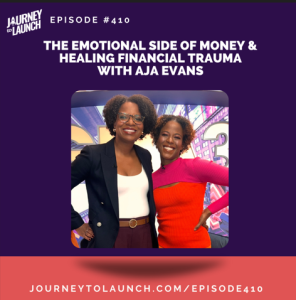
Click Here to Read the Transcript for This Episode
- Get Aja’s book, Feel Good Finance: Untangle Your Relationship with Money for Better Mental, Emotional, and Financial Well-Being
- Get your copy of my book: Your Journey To Financial Freedom!
- Join The Weekly Newsletter List to get updates, deals & more!
- Leave Your Journey To Financial Freedom a review!
- Get The Budget Bootcamp
- Check out my personal website here.
- Leave me a voicemail– Leave me a question on the Journey To Launch voicemail and have it answered on the podcast!
- YNAB – Start managing your money and budgeting so that you can reach your financial dreams. Sign up for a free 34 days trial of YNAB, my go-to budgeting app by using my referral link.
- What stage of the financial journey are you on? Are you working on financial stability or work flexibility? Find out with this free assessment and get a curated list of the 10 next best episodes for you to listen to depending on your stage. Check it out here!
Connect with Aja:
Connect with me:
- Instagram: @Journeytolaunch
- Twitter: @JourneyToLaunch
- Facebook: @Journey To Launch
- Join the Private Facebook Group
- Join the Waitlist for My FI Course
- Get The Free Jumpstart Guide
Aja Evans 0:02
It's not just about stability and security, but it's also for enjoyment, like you should enjoy your money too. But a lot of times there are barriers that we don't realize that are coming up for people. So taking the time to really sit and take stock of what's the emotion coming up for me, and what am I not enjoying about my life that I want to but something is preventing me from doing that. T minus
10 seconds. Welcome to the journey to launch podcast with your host, Jamila Souffrant as a money expert who walks her talk she helps brave journeyers like you, get out of debt, save, invest and build real wealth. Join her on the journey to launch to financial freedom, 543218,
Jamila Souffrant 0:52
journeys before we get started, I wanted to let you know about a special, special offering that is happening right now that I don't want you to miss. Now, if you're on my email list, and you would have gotten emails this week about it, but just in case you're not, I have opened doors to my signature six week group coaching program that includes my course map your path to financial independence. Now this is significant because I have not opened this up in a while. This was last done late last year, and the feedback from the students that enrolled in the program and that got coaching for me was phenomenal, and so I'm opening up doors again to help you start your new year off right, to help you get those goals and aspirations you have in your head and heart into reality, to help you map out how you with your specific situation, can reach financial independence. And so this is my signature program, where you get a tangible course with all you need to map out literally, how you get to where you are, to where you want to be, where you can plug in your actual numbers with the help of my fi calculator, my proprietary tool that I've created to help map out where you need to be, along with the 10 steps to do that. So that is the course. But what I really think makes this program amazing is the additional group coaching and personalized help that you get from me throughout the course of the work. And so there are going to be coaching calls and time for you to implement what you're doing in the courses hit feedback, where I help you map out your path to financial independence. So if this sounds like something you are into you want to do, then you need to hop right on it, because doors will be closing at the end of January, and you can go to journey to launch.com/coach me to find out more, that's j o, u r n, e, y, t, o, l, a, u n, C, h.com/coach, me, C, O, A, C, H, M, E, where you can find out more information, you will be able to see all the bonuses that you get once you join, which includes the budget boot camp, the fire Calc, a small pop up community, and, of course, more information about the group coaching calls, the before group coaching calls, and what I really want to do. And what makes this such a magical experience is that we're keeping this group small, so that way I can really get to know everyone who joins so limited space available, and people have been signing up, and so I didn't want you to miss your opportunity, you can go to journey to launch.com/coach me. For more information, there is a special discount, an early bird special, if you sign up within the next few days. But if not, doors are open until the 26th january 26 and we start the program on january 27 go to journey to launch.com/coach me for more information. If you want the episode show notes for this episode, go to journey to launch com, or click the description of wherever you're listening to this episode in the show notes, you'll get the transcribed version of the conversation, the links that we mentioned and so much more also, whether you are an OG journeyer or brand new to the podcast, I've created a free jump start guide to help you on your financial freedom journey. It includes the top episodes to listen to, stages to go through to reach financial freedom resources and so much more you can go to journey to launch.com/jump start to get your guide right now. Okay, let's hop into the episode. Hey, hey, hey, journeyers, welcome to the journey to launch podcast. This week we have a special guest, Aja Evans, in the rocket seat. I can't remember the last time I said rocket seat with a guest, but I guess you're bringing back the vibes, the launching vibes. But Aja, let me just tell you a little bit about AJ and why you're going to be ecstatic and learn so much from her. Aja Evans is a licensed mental health counselor, speaker and author specializing in financial therapy. She has over a decade of experience and is determined to help people break the taboo of. Keeping money and emotions secret. In addition to her practice, Asia is the President Elect on the board of the financial Therapy Association. Consults with FinTech companies and is author of a brand new book feel good finance, which is out right now. Fun little backstory. AJ, I just want to, like, tell people how we I know we met before, but we really, really met, because we were both on Good Morning America. What was it? It aired in December, early December, or was it November? I don't even know, November. Was it okay? And so it was really nice to to finally, kind of get to know you more in person and see your expertise in action. Because, as you know, Good Morning America. It's quick, and you gotta hit your talking points. And with that segment, we were talking about financial infidelity, so we're gonna, I want to talk about that a little bit, just because I think that's important to kind of share just strategies around that and what that is. But yeah, it was the first time that we actually kind of like got to work together. And your book was coming out. I don't think it was out yet. I was like, you gotta come on the show. Let's go. Let's go. So finally, happy to have you on and so a big just welcome to the podcast.
Aja Evans 6:09
Ah, thank you. I'm so glad I I feel like I've been a fan or in the orbit, and that's it was just such a beautiful, serendipitous moment for us to be on Good Morning America together to actually, then have, like, a more in depth conversation and see each other in our element, which is just so you know, like, what is that you see? Oh, hey. Like, just casually go on Good Morning America and have these conversations together, and then, like, let's hook up and collab. So I'm just really grateful and happy to be here.
Jamila Souffrant 6:40
Yeah, so I want to dig into a bunch of things with your story. I think where I want to start is with your evolution and journey into your current career as a financial therapist, how you came to this point. But in order to get there, we got to go back a little bit. How did you land in this field, and where did you start? Was this always your goal? Or did this happen?
Aja Evans 7:01
Yeah. So it was, it has always been my goal to be a therapist. So I decided when I was a little, little baby, I was, like 12 or so, like, very young, that therapy was, was my passion. This is where I was going to go. So, you know, I took all the steps, went to grad school, got my Master's in Counseling Psychology, and started the work of being a therapist. So I am a licensed mental health counselor in New York, and had been doing that work for you know, my whole career. My whole career is in mental health, and it wasn't until I was a mid 20 something living in New York, living my best brunch in trying to send my laundry out because I thought I was cute, like doing all of the things. And that really was like, girl, you cannot afford all of the things at the same time. So as I was checking my bank account on my Blackberry underneath the table at a group dinner, or having conversations with friends or, you know, just trying to pregame before going out, because I definitely couldn't afford $20 a drink kind of thing, like all of that, I realized that I wasn't feeling as good as I thought I should be feeling. I wasn't feeling as financially secure and felt also, I'll be honest, like insecure in myself, when I couldn't keep up with my friends, when my friends were in marketing or advertising or were had different jobs where they were not making what I was making, and at that time, I was making about $60,000 and as a 20 something that felt like a lot of money to me, like that was a ton of money when I didn't have any other major responsibilities outside of myself. But I could not keep up, and I felt bad about it. So that was kind of my introduction to my own financial awakening. And let's start paying attention to money. And that's when I deep dove into, you know, the recesses of the internet at this time, because, you know, it wasn't as easily digestible as it is now. It wasn't on social the same way I was hunting down blogs and reading everything I could, and like scouring a Business Insider for all these articles about people who were, you know, paying off debt or student loans or just making it happen. I just, like, really loved the information and couldn't get enough of it. And then that's when I was like, Oh, how do I combine the two? And I thought I was gonna leave mental health and become a CFP and go through that process, but it just that didn't feel quite right for me either, because I wasn't ready to completely walk away from mental health. And then I found the financial Therapy Association and the Center for Center for Financial social work and trauma of money. And I was like, Oh, this is it? Like, this is what I'm trying to do. This is how I want to marry money and emotions and what we're doing with our finances and our behaviors. And after that, I just continued to get more involved and decided, like I had a lot to say and wrote a book, and it's just been put one foot in front of the other since then.
Jamila Souffrant 9:56
I love how you describe your financial. Awakening, leading you where you are now. And I talk about this too in my book. This before awareness of financial independence or the financial life, like we're all on the path, whether we know it or not, whether we are intentional or not, and there are these things that we're doing that is going to impact the journey for sure, and when you're aware now, like when you come to an awakening of, wait a second, let's like, stop sleep walking like I'm waking up, I'm seeing things differently. It can be a shock, because especially when it just comes to your regular personal finances, like how much you didn't do or you let go, and how much further you could have been. And yes, it brings on all these feelings of like, shame or regret and feeling bad. So I think that financial Awakening people have it at different times. And I don't think it's going to be the same for everyone, but I do know, like, once that happens, and there's like, no looking back like you, you either like in your case, it seems like it prompted you to want to make changes to your own personal finances and and your career. Yeah, 100% and
Aja Evans 11:01
honestly, as a therapist, they talk about niching down all the time, like, oh, find your niche. Go into your niche. And I was like, No, I'm a generalist. It's fine. I don't really need to do that. But I will say, since I've really decided that this is my life's work, and I feel so passionate about it, like I could talk about this stuff all day long, I was like, Oh, I'm seeing the difference in my career and the possibilities for what my career could look like. Because I'm also a very entrepreneurial therapist. I do like the business aspects. I want to do the clinical but there's a lot of other nitty gritty stuff that I want to get into. So expanding my career, because I'm having these conversations. You know, sometimes there are ups and downs, as every entrepreneur for what is lucrative, but I feel really lit up in what I'm doing and what I'm talking about and the access that I get to kind of have conversations about how it's impacting everybody, because we all have to deal with money, no matter how much or little you have. And
Jamila Souffrant 12:00
what I love too, is that when you are interested in something, you will find that there are people that probably have done this before or thought about it, there's communities, there's resources, and so yeah, sometimes you're trailblazing and you're the first but usually there is something there's like a your tribe, your community there, and it sounds like you found this pathway to help you with this new transition. So I think that's just important, because there's so many people who are in the social work field, the therapy field, and maybe they're not finding that it's earning depending on their specialty or how much it costs to go to school, because I know that's another thing. I don't know if you graduated with student loans you did, right? Okay, so I think for so many people, when it comes to this career journey, life journey, a lot of it is spent working, and then if you don't enjoy what you do, you want to give back. So I often think that choosing a job or a career in social work or therapy is very much of wanting to help and give back and community based, and that doesn't always pay depending on the field or the type that you do. So hopefully this is giving some ideas to people, if they are in a current field, this field, and it's not something that they feel like financially is providing for them.
Aja Evans 13:14
Yeah. I mean, I could go on and on and on about like, what our systems say and clearly invest in and unfortunately, it's not always investing in people. It's not always investing in mental health, which you know, if people feel good about themselves and their family and their environment and their relationships, like that leads society to be better, right? Like happy people are helpful. We are all better. For all of us being happier. But that's not always where people want to invest their money, and it is. It is really hard for baby therapists coming out of school, because we do. It takes a lot of schooling, and schooling is very, very, very expensive. And coming out, people do go directly into private practice, but that doesn't always mean you have the business acumen to handle being a private practice. So it just is a lot of nuances. And what I will say is have these conversations with people, talk about it, look into what other people are doing, because it is going to be hard in the beginning, especially when you're trying to get licensed. It's a lot of time, a lot of hours, and you're you are underpaid. It's chronically underpaid, but you will not always be there, I promise. Yeah, well, I have a special heart, just like with teachers, with social workers. My mom was is a social worker, and so that's what she went to school for, got her master's in eventually, and she works in the school system now. So I feel like and my little sister also is going through that process. So I know a lot of this is hopefully introducing people to a new pathway in therapy that they may not have known about. So yep, I want to get back to kind of your entrepreneurship journey, but I want to get into financial therapy and what that is. So can you describe what financial therapy is and who would need financial therapy? Sure. So financial therapy really is about diving into your thoughts, feelings and behaviors around your relationship with money. So for. Me, there are many people who could be financial therapists. I'm coming at it from more of the emotional side. So I really want people to come sit down on my couch in my office and have a conversation about their relationships, about money, how does it show up, and who they are as a person. How do they feel about money? Where there may be some other people who are going to talk about your feelings, but they're also going to make sure they're integrating that into your financial plan, so like a CFP type of thing. So looking at who you need in your life right in that moment is going to be really important to then delineate, like, hey, what kind of financial therapist should I be talking to? So when it comes to people, like, when do you know you need a financial therapist? Or when does it feel like it's a good time to start having some of those conversations or reaching out? I would say, if you find yourself feeling bad about your money, whether you have all the money in the world or no money, and you're just consistently feeling bad. You're consistently feeling shame, anxiety, stressing out about it, feeling bad about yourself, if your negative committee is saying really bad things about yourself when you make a money mistake, that's a time. And if you just kind of feel like, Hey, I have been on the same cycle, the same pattern all the time, year after year after year, and I cannot break it. I know what I need to do with my money, but it feels hard to do it, that might be a time to come talk to somebody like me, because we need to figure out not just the root of that pattern, but we need to figure out what you need to do to change the pattern. And that's the hardest part. A lot of people come to me and they think that, Oh, I just need to know where it comes from. That's the hardest part. Just understand where it comes from. I'm healed right now that I get it. I'm like, Oh no, Boo Boo. I'm so sorry. That is not what the case is. What the hardest part, really is, when I'm gonna ask you to do something different than you've been doing for the last decade or so.
Jamila Souffrant 16:49
That concept, which is, I think, true about why we do the things we do, the root, like the inner work it takes. Now I talk about this, but I am no like, licensed therapist, so I love that you're here to kind of really give validation to what I believe is something that if we all could talk to a financial therapist or have like a conversation at least, would be helpful on are just tangible money goals that we want to have. Because often say it's not that people don't know what to do. Yes, some of it may be ignorance, or they literally just don't know concepts and things like that. Is possible. That's a case if people are just not raised or exposed or educated in certain topics, like investing and you know, but a lot of it is, you know, what you should do, like, you can google how to budget. You can google how to invest in my Roth, Ira. You can literally the information is there. But oftentimes this is like, why am I not doing it? Why am I afraid to look at the numbers? And that, like you said, is where it all starts from. Why am I under earning it could be like, a legit reason that you're in a profession that just there's a cap and doesn't pay, and this is systemic reasons for being underpaid. But then it's like, is there deeper because you're not showing up in a way where you can demand or ask for more money. There's all these things that it literally starts from within. So I'd love for you just to talk more about working on your inner self and that shift that needs to happen so we can see the tangibles occur in our life.
Aja Evans 18:14
Yeah. So I would say, like a lot of people are talking about, you know, mindset all the time, right? It's your business mindset, your scarcity mindset, your abundance mindset. What's your mindset, healthy mindset, like? And that is part of it, but your mindset is really based and rooted in where you came from, how you grew up, how and we're going to talk about money specifically. But how was money talked about? What are the money beliefs that you have? And then, how are they either helping you or hindering you? And that's the kind of harder work that I start asking those types of questions in the book and in feel good finance to understand, like, Why do I feel bad about my money? And it doesn't matter how much you're making. I cannot stress this enough. I think a lot of times when people are either following personal financial information or content creation around money, there's this idea that it means that everybody's in debt and they don't have any money and they're struggling and trying to figure it out. No, there are people who have millions of dollars who do not look at their bank accounts because they're worried. There are people who have, again, six figures worth of savings, and they still feel like, Oh, I can't invest it right? Like you shouldn't have multiple, multiple six figures of your money sitting in any kind of account, like it's not safe. But there is some kind of belief barrier struggle that's preventing you from doing things that are going to help you build your wealth. So a lot of times, that's what I'm trying to get to for people. That's why I'm trying to have these conversations about, listen, how do you feel about yourself, and why might that be coming up in your overspending? And at the end of the day, I really believe people want to feel seen. They want to feel a part of the community and will spend. Their money to feel like, Oh, if I do this, somebody's going to see me as this versus what is the work that we need to do so you see you as this and that you aren't as tied or connected to how other people see you, because it's just shining out there. And that is where the real work is. That's where we're dissecting, you know how you feel about yourself, how does money show up, and how you cope when you're stressed? So I'll use myself as an example. If I'm ever stressed out, get bad news or uncomfortable, the first thing I want to do is go eat. And I don't want to go eat at home. I want to go eat out. I want to get takeout, go to a restaurant, spend time talking with a friend, family member, whatnot. And I can say that is the behavior change that sometimes I need to make when I'm above my budget, it can be so painful to tell myself No, and I'm like, don't do it. It's almost like holding myself back. Do not go get that ordering or whatever it is. But really what I'm trying to reach for is what I have made a coping skill for myself, and the same way that I tell my clients, I have to tell myself, Okay, what else can you do that is not going to spend money on food because you don't actually want to spend the money right now, and sometimes that's going for a walk, taking a shower, calling a friend. Sometimes, for me, honestly, I'll just sit and cry. I'm all about people just being in their emotions. Sometimes it is so stressful or overwhelming and you're so pissed that you can't just, you know, willy nilly, unintentionally spend your money, that sometimes you do just need to cry, but it's hard to just sit in the emotion we want to move out of our emotions very, very quickly, but that leads to some maladaptive coping strategies.
Jamila Souffrant 21:42
Yeah, you when you talked about money sitting in an account, I find that I definitely bet a lot of people have heard from a lot of journeyers who just talk about the being scared to take their money and invest and yet, I think there are the people who are not earning a lot do have income issues, and have to figure that out. And then then people like you said, who are earning good money and still are are not able to manage it. And so it's not an income issue, it's more of an expense issue, and maybe coping issue, because they're coping over coping or trying to overcompensate a bit for certain things. And so with that, what are some tools? Now I know, obviously it's best if you can work with therapists, that's best, but what are some tools to recognize it as it's happening? So here's the thing. I feel like the same thing that's preventing people from maybe making the changes they want to see what their finances and being stuck in a rut would then be the same people who may possibly not seek out a financial therapist or want to pay for one. So how does one know in that moment that it's time to seek deeper health or maybe help, or maybe there's a way in which they can shift or start talking to themselves in a way or treating themselves differently to help? Yeah,
Aja Evans 23:01
yeah. So I'm not going to go too deep in it, but I know culturally, talking to people about what feels like very private information, where that's money, what's going on in the house, is not something that, like, I was like, oh yeah. Definitely can't wait to go talk to a therapist about this. Like, culturally, that is not something, especially in our communities, that you do. So I am pushing a lot of people and clients to move out of the narrative that we have to kind of sit and hold this discomfort for the sake of maintaining secrecy and privacy and it's nobody's business. It may be your new therapist business if you are struggling, if it is preventing you from being better, preventing you from creating more money to give yourself or your family or other people around you a quote, unquote, better life or a less stressful life like you deserve that you do, but sometimes we believe that we have to be the ones who do it ourselves, and that really does prevent us from growing sometimes, not all the time, but definitely sometimes. So recognizing that some of those narratives may be holding you back that say, Hey, I should be able to figure this out on my own, and I'm like, Well, why I went to grad school to go figure this out. I have 15 years doing this. That's why I can figure this out for you. So let me help you make this happen. So that's one thing, but once we kind of move through that and pass that, it's when you recognize that, are you waking up in the middle of night stressed out about your money, no matter what you have. Are you thinking about? Oh, my business. What do I need to do with my business? Do I need to do this with my business? Maybe I should try that. Do I need this course, obsessively checking your retirement, obsessively tracking your spending? And there's a difference between tracking your spending and checking in with it, and like going through every single. Transaction every single day, wondering if this is okay, did I do the right thing? Should I have not spent that money? If you're really struggling to spend money that you do have right? You met all your financial goals, you saved the amount you wanted to save you were pouring into your retirement, or you are retired, but you feel like it's still a hard thing for you to actually go and spend that money, then we need to talk about where that fear is coming from. We need to talk about, how do you make sure that you remind yourself that you are stable and that it's also not just about stability and security, but it's also for enjoyment, like you should enjoy your money too. But a lot of times there are barriers that we don't realize that are coming up for people. So taking the time to really sit and take stock of what's the emotion coming up for me, and what am I not enjoying about my life that I want to but something is preventing me from doing that? Yeah,
Jamila Souffrant 25:53
and oftentimes I think too, like getting to, like the root or cause or the effect and all these things, like they're very intertwined. So sometimes maybe like an issue, I'll just maybe bring up something that I've definitely just had in my life or not struggle with, but maybe have prevented me from earning more money, even in my current business is showing up online a certain way, like so I don't think this is necessarily a bad thing, but I do consider myself more of a private person, like I have this idea that I don't necessarily want to share everything with everyone. Like, I want to hold things like, close to me, which I think is fine. But there's also this part of me where, you know, not maybe wanting to show up sometimes, is more being very conscious of like, what other people are thinking of me, which, what? Sometimes, when I see people, I'm like, Oh, I it almost seems like they don't care, like what people think, and they're just like doing whatever they need to do. And if I didn't have that block of caring too much about what other people thought, then maybe I'd show up differently, and that would then help me make more money. But it's not necessarily a direct money problem, but it impacts money, yes, and so I find that that happens for a lot of people where, yeah, like, they don't know or understand how whatever behavior they have is that domino effect is falling down to impact their money. But it is. And so I think understanding like that is probably an issue for some people, or a lot of people,
Aja Evans 27:15
Oh, totally. And I think the the crux of what you're talking about is the assumption that it's a money problem. The things I'm talking about are never money problems. To your point, it's okay, do you have enough income? Okay, we might need to get some more money. We might need to make more money. Or do you need to know the information? Easy, quote, unquote, easy solves, right? Like you can get the information, but it's rarely a numbers problem. It's rarely I don't know what to do with the money problem. It's mostly the feelings that like, oh my goodness, what's coming up within me that is either blocking my blessings, not allowing me to show up the way I want to, stopping me in my tracks. That is now almost like a money avoidant thing you're doing without realizing it's money avoiding, but it's so rarely about the money. It's you, the money's the first few layers, and after that, then we're getting to the real stuff of like, who you are as a person, and what it means to be able to show up in your shoes with your life experience. And that is not always something people are ready to go tackle that's really difficult working I'm I'm asking people to go dive into the deep recesses of who they are and their identities and like, Okay, let's go dig around. And it's uncomfortable. It's not easy, but I want that so that people can come back out and make more money and do whatever they want with their money that feels good to them, or help their families or friends and and show up and intentionally spend and enjoy their money without doing it, because it's like, oh, it's just gonna make me feel better. It's mindless. It's not gonna always be perfect. I'm not always perfect either, but I would rather people do the hard work to feel better about themselves and to enjoy their money and hit their goals then pretend that they're living their best life because they look good on the outside.
Jamila Souffrant 29:04
Hi Jamila here, host of this podcast and author of the book, your journey to financial freedom, a step by step guide to achieving wealth and happiness. Just a few years ago, I was in a job I didn't like, with a long commute, feeling stuck. I knew there had to be a different, better way then I found the pathway to financial freedom and financial independence. Today, I have more money options and freedom than I ever thought was possible, and in my book, Your journey to financial freedom, I'll show you how you can achieve that too. You'll learn how to spend and save responsibly, all while enjoying that spicy Margarita and exercise of guacamole, determine where you are on the journey and evaluate your spending and saving goals accordingly. Quit your job, retire early or reach financial independence. My book your journey to financial freedom, a step by step guide to achieving wealth and happiness, is out now and available on Amazon bookshop.org, Barnes and Noble. Goals and more. You can leave and listen to the audiobook narrated by me. Go to your journey to financial freedom.com. To get a free bonus when you order the book and see all the places to buy it once again, go to your journey to financial freedom.com. We already touched upon culturally, maybe why people have a hard time talking about money and feelings. But can you talk a little bit about the role of generational trauma and our cultural influences and how that impacts our life, and how to break so if you are aware that there's an issue and that you have continued that trauma, and now as an adult, like, how do you then break that cycle? Yeah,
Aja Evans 30:46
so I think you nailed it when you said the first part of it is that you need to recognize what it is, and most of our kind of money beliefs and money mindset and kind of the foundation of how we think about money came from the people who we were closest with are the people who were raising us. But we need to be thinking, Where did their information come from? So that's two generations away. I mean, for me, my grandmother could not have a bank account by herself, right? My grandmother couldn't get a mortgage by herself because she was a woman. She was a black woman, like all of these things. So you have to think about the messages that were then passed down to the people who were raising you, and you have to dissect them and decide, does this remain true for me today? Does this apply? Was this fear instilled in me because it was a real fear for the people who raised me. It was a real concern for their parents and take the time to realize, Oh, these beliefs are no longer what my life looks like. I understand why they were protective to those people before me. I appreciate that they were trying to protect me, but now I need to shift out of them. Now I need to make sure that I am stewarding my wealth in a way that feels really good, or helping my you know, again, my family, my friends, myself, but first, we really do need to recognize what those beliefs are that might be holding you back. And that's the hard part, right? So some of my clients will come to me and say, Listen, when I was growing up, it was kind of feast or famine. It was we are rolling in the dough. We're eating caviar and lobster all the way to like, Hey, I don't know if the lights are going to come on when I come back home. And that can really impact what a person does in their life. Even if they're making a million dollars a year, right? It may feel like, oh, I need to make sure I'm saving so much money so that that never happens to me, but that then hinders their ability to live fully and enjoy their money and potentially pass a different message on to their offspring or the next generation or whatnot. So being mindful of where those messages came from. Are they impacting your life today? How are they impacting them? And then, what do you want it to look like? So not even, what do I need to do? But what do I want it to look like moving forward, and then we can tackle the how and the healing and the let that just be the truth, and it's part of your story, but it doesn't need to be the only story,
Jamila Souffrant 33:14
right? As you were saying that I'm thinking about just now, that I am an adult with children on my own, and like growing up, and not just like money, but just in general, their childhood and what one day they may when they get therapy, if they get therapy, what they will be saying on their therapist couch about their mom and dad. And so it sometimes feels like I know there are probably very obvious things you shouldn't do and shouldn't say about money, like, you know, maybe with that feast or famine, like, where you are just so reckless with your money, you know, that's not a good thing. But when you're so maybe stringent and kind of a miser with your money, and that's not a good thing. But I do think there's so much where it's like, you just don't know you won't be able to do it perfect, like you said. And I think part of two is like letting go trying to be perfect. Because even as I think about how we are raising our kids and how we talk about money, it's like we, you know, we have some tools in place, and I have some experience in talking about money. So it is, I definitely feel more confident and comfortable. But still, even in that, I'm wondering, oh my goodness, like, I'm sure there's something where 15 years from now, or 20 years from now, if they go to a financial therapist, they're going to say, Well, mom didn't, or mom did this. And so I don't know, is there a certain are there some guidelines on how to positively talk about money in a household, and so you don't bring that trauma over from before? Yeah.
Aja Evans 34:39
So what I will say, and it comes up with parents, and I'm a parent too. Our kids are going to be impacted by who we are, and we are impacted by who our parents were, and they are impacted by who their parents were. So, you know, especially like in therapist community, there's like, the quote, unquote, we're all going to mess up our kids somehow. They're going to go need therapy because of who I am as a person. Now. That may or may not be the case, but who they become is going to, you know, be impacted by our own baggage that just is like that is just the case. It doesn't mean that you did a bad job. It doesn't mean that you should have done better. For some people, you know, we're not going to go down the road of, like, very traumatic upbringings for people, but I think what it we need to like, let go of the I can control everything my kids think and feel and see from me, and that is not something that's possible because they are having their own experience the same way that you are having your own experience. So to your point, dropping the the need for perfectionism, we have to let it go. We cannot control it. And guess what, even if we think we're controlling the narrative, your kid may have a totally different perception about what was going on, and you're like, No, that's not what I wanted you to
Jamila Souffrant 35:51
think, right? Yeah, it's so funny. There was this on I found this guy on Instagram. He does like the funniest thing. He's like, Oh, your kids, whatever. Years from now on, a therapist counts, like, when they had a good childhood. And like, he's like, crying, he's pretending to cry, and he's like, you know, my parents, you know, I had my own room, and we went to Disney every year. And how much fun could one kid take and like, so it was, like, a kind of a joke, but like, the kid, he was saying all good things, but the he was still complaining or crying about, like, his childhood. So it just feels like, All right, listen, even if it is and we think it's perfect, it's never perfect. So,
Aja Evans 36:24
right? And they have their own perception. And it's also like, we need to debunk the the notion that therapy means something's wrong, or that somebody did something bad, or that somebody is wounded. It may just be like, Hey, listen, I want to make sure I get to know myself better. I want to be a little bit more insightful into the reason why I do certain things like therapy, is just saying, Hey, I'm looking for an outside perspective to help me make sense of who I am, my life, my past experiences, and how I'm trying to show up in the world. So it's also like therapy is not a bad thing. It doesn't mean you messed up. It just means your kid may, just as an adult, want to make sure that they're a little bit more introspective, which is a great thing. But to answer your question from the beginning is like thinking about, like, how do we have these conversations about money with our kids that make sure that it's grounded in, you know, positivity and not necessarily negative or scarcity or that sort of thing. So make sure you're having age appropriate conversations with your kids about money, but make sure you're still talking about money. If we all act like, oh, it's about money, don't talk about it. Oh, it's secretive. Oh, it's too private, we're not gonna, you know, tell them about it. What they end up growing up thinking is that like, oh, I can't talk about money. We can't talk about money. Money Money is shameful to talk about. We don't do that, but I don't want that for anybody. So having the conversations about money, but making sure that they're age appropriate, helps your kid grow up realizing that they can have a conversation about money, they can bring it up, but it's not something that only certain people navigate, like we all have to navigate money no matter what. So let's be able to talk about it, making sure that people know. Like, okay, yes, we do need personal finance, right? You do need the education. You do need to understand. So as your kids are growing up, give them the information, like, make sure they get it. Make sure they know. Make sure that they're, you know, don't have the elder millennial experience of going to college and, you know, signing up for a credit card without realizing what you're actually doing. Tell them, like, teach them and tell them. And if you don't know, let's get you educated. So then we can get them educated too. So I would say the biggest things are helping them understand, like, what's actually happening with the money moves the education piece, making sure they understand that communicating about money is not a dirty thing. It's not a bad thing. And then I'll add the bit about feelings and letting them know, like, listen, it's really hard when you don't get what you want. It's just hard, and that's okay, right? Like, I've got a toddler, and when he doesn't get something so simple, it is quite literally, like the world is ending, and I know that that is him just learning how to be disappointed, and that is something that we all have to navigate, even as adults, that sometimes you don't get what you want, sometimes you have to tell yourself No, sometimes you have to hold boundaries with yourself and with other people, and that's complicated. So helping them grow that foundation of disappointment and owning their feelings and just sharing their feelings is going to be really important too. I
Jamila Souffrant 39:27
love that learning how to be disappointed. So let's kind of move to relationships and money. Because, as I mentioned, we were on the Good Morning America and talked about financial infidelity, where partners are experiencing someone is not being honest about money, and maybe lying about it, stealing it, and so it's creating an issue. So I know for couples, whether you're dating or married, that you are now not only by yourself, do you have. Hard time, or can't have our time with your money. Now you're combining with another person who has their own live experiences, own background, own culture. Thing happening. So what would you say, or what are some of the things that you see with couples, if you talk with couples, and starting points for someone who needs to have a conversation with their partner, or they need to go to therapy together. Like, what does that look like when things are off balance, and how can they begin to fix it?
Aja Evans 40:25
Yeah, so I would say from the jump, if you are a new couple, start talking about money. Please. Talk, talk. Talk about money. The communication with couples about money is so poor, unfortunately, and I think it's about vulnerability. It's about not wanting to feel like you don't know what you're doing or don't know the information, but it's really important to have the conversations about money early on. It doesn't mean you need to, you know, open up your whole wallet or get completely financially naked with somebody that quickly, but it does mean that you need to start having some slight information about what their financial goals are, what do they want their lifestyle to look like? Because that's all going to be important as you move through your relationship together. But if you are, you know, coupled in any way, and are finding, hey, some of this stuff about you and your money baggage is, like, really rubbing up against me and my money baggage. How do we talk about this? One of my favorite things is a money date. I think everybody should be scheduling a time at least once a month to have a conversation with their partner about the money. Both people in the partnership need to know where the money is right. Like, what's going on? Do we have a joint account? Where is our retirement? If it's only one person's retirement? Are you saving for retirement? Like, have the conversation about the money as well as, like, what do our monthly expenses look like? What's our income looking like? And the thing about a money day is that everybody knows it's coming, because it is scheduled. It is planned. So nobody's being blindsided by this. Nobody's like, hopping into bed, which I unfortunately do My poor husband, and like, oh, let's talk about our money. Let's talk about this or this is coming up. Like, don't be like me, right? That is a mistake. I'm working on it. Don't blindside your partner. Like, sit down. Have a conversation where they're prepared and they know what's coming. And you also can prepare your thoughts, so you're not just kind of reacting to something else that was going on. And then the next thing I always say for people is, use I statements. Do not sit down to this money conversation and be like, You, you, you, you, you, and you did this and you did that, and you know what I mean? I feel I'm worried I'm going through in my past. I like it really should start with like, how you're feeling, what you're going through, because it leaves an open room for dialog, open conversation, instead of kind of coming in and the other person might be defensive, like, I don't want any of you bringing up walls when you're having this conversation, because they're already hard enough to talk about money. So I feel statements and then making sure you have a money date, so that there's open lines of communication, and try to give each other Grace during it, because I think a lot of times people want to point the finger.
Jamila Souffrant 43:05
Do you think that it's possible for two people who do have completely different money narratives and the way they handle money to come together to have a successful financial and just love relationship? Yeah,
Aja Evans 43:18
I do. I'm a lover. I'm an optimist and I'm a lover, so I want to believe that anybody who really wants to make sure that their relationship works can make it work, but both parties have to be willing to do the hard work to get there, and that might mean sometimes owning your own baggage and making some changes, or going to therapy or having different kinds of conversations. But, yeah, I'm a lover.
Jamila Souffrant 43:45
No, I agree. I think, like you said, both people, though, have to want it and be willing to compromise, or to at least hear the other person out without thinking that person is 100% wrong in their thought process. But that openness and willingness to meet somewhere different than where they currently are. Is it important? So I know you've been now doing this for 10 years. Correct about
Aja Evans 44:07
um financial therapy? No financial therapy itself. It's probably about five years, but um therapy is about 1515,
Jamila Souffrant 44:17
okay, so with that, you are an entrepreneur. You mentioned that people can come to, like, your a physical location, like on a couch, and talk to you, yes, right? Which I actually think it's good to kind of just say that, just so people can visualize, like, it's not I'm sure you probably do virtual sessions too, but like this is actually like a place people can come to talk to you, which I think is really like, great. So how did you find or how have you found your evolution into switching into this field and then making it sustainable, like earning money and marketing yourself? I know you just you wrote the book. The book is out, but that's another part of it, right, where it's helping people find you. So I'd love to just kind of dig more into your entrepreneur. Entrepreneurial journey and what that looks like. Yeah,
Aja Evans 45:03
so I'm like, not even sure how it started. So when you are a therapist and you go private practice, you're already, like, you're now choosing to run a business, right? Like it is your business. You're getting all the insurances that you need. You might be opening an office, like, I have an office to your point, like a physical space, that people can come literally sit on the couch with me and do therapy. So that was that aspect. But then when I realized that people weren't talking about this enough, we weren't having these kinds of conversations, that's when I started speaking more frequently and trying to educate people about what this looks like and how their psychology shows up in their financial behaviors and in their feelings and the integrating finances and emotions and mental health and finances. So that was, like my first forte into it, and understanding that then there were some companies who came to me and were like, Hey, can we have a conversation about what this might look like? Because we do see this happening with some of our clients with some of our members. So that got the ball rolling. And I didn't realize before I wrote the book, but I have always been a writer, and I didn't think about it that way, but I was like, You know what? I have something to say, and I can't see everybody. I cannot have everybody coming to my office for therapy or even virtual sessions, and how do I start to get some of this information out there more frequently? And it's a lot of lived experience. It's a lot of experience from my clients, but that's kind of when I started to dive in. And I'm going to be very clear, I can have this conversation and tell you, but it comes with a lot of bumps and bruises and hills and valleys and mountaintops, because when you're an entrepreneur, you don't always know what you should be doing, quote, unquote. It feels like there, and you mentioned before, should be a path that you follow, and you don't always know what that path is. And you do want to know. And I'm very type A, I'm a Virgo. I want somebody to tell me what to do so I can do it right. But when you work for yourself, there isn't always a direct path. There isn't always it's kind of like, okay, well, what did you do? That doesn't really apply to me, but this can apply to me, and how does that work? So having a community and asking questions and being vulnerable, because sometimes it is vulnerable to just be like, Hey, do you mind helping me and and starting to have this conversation? So it's, it's a journey like this did not happen overnight, like I've been building this, this person,
Jamila Souffrant 47:32
yeah, I think that's really great to share, because entrepreneurship is, you know, it's definitely not for everyone. I think a lot of people just, you know, if you you might find that you just work better in an environment that is contained and just like structured, and you know what happens every day, and you get a check for that, whether you know, you can kind of show up and you know, halfway do it or not, versus this idea of there's no One like, I just remember when I did work in corporate America, even though I did not enjoy having a boss, at least I knew, Okay, they told me what to do. So here's what I do. And if I want to go a little bit above, then I could do that. But I know the standard. And then when you have your own business, you're like, wait, wait, I like create the standard.
Aja Evans 48:16
Listen, sometimes I miss having a job. I'm like, yo, those benefits, though, that sounds great, like a nice Sick Day. Ugh, sounds amazing, but, yeah, it's really hard, right?
Jamila Souffrant 48:27
So I think with that too, it's just recognizing if you happen to whether you are working full time and and think you want to be an entrepreneur or doing something on the side, or you're a current entrepreneur, and maybe you're reminiscing about the time when you did have a constant check, but you are enduring something, maybe the fruits of being an entrepreneur, that whatever those feelings are, I think, are just valid. They're normal, because it happens on both sides. Like it's, I rarely find anyone on in either situation that says it's 100% perfect, and I don't want anything to change. Like there's usually something where you're thinking about the other side a bit, and so
Aja Evans 49:00
it's normal, it's okay. It happens to all of us, peaks and valleys, honestly, like peaks and valleys. And it's also what people you know, you may see on social media, people catching flights, flying private, having the best time. And that is all beautiful, but it does not always look like that. It took somebody a lot of unwavering faith, a lot of hard work, a lot of time, or somebody's a lot of money to get to the point where they're able to have that level of flexibility. And flexibility can be amazing, but it doesn't always mean you're getting paid during that flexibility, right like so I think it's just understanding that to your point, sometimes the grass is always greener, but realizing that you would rather choose to do this work on yourself while also building your business. Because that's one thing we don't talk about enough, is that when you work for yourself, you are constantly pushing towards something, but you're also working. Focusing on why you're pushing that something. What about this inside of you says it's important for me to keep going. I cannot go find a job. And for some people, it's also being brave enough to say, I don't want to live like this. I don't want to do this. I do want to go back to a job. And I think there's a lot of fear of judgment in that, too. So it's just, it's just hard for a lot of ways that you're not anticipating it to be hard, right, right? I think what I want to end on, or at least, like give some advice to people, hopefully, is that most people listening to this, I would assume, have the goal of wanting to reach financial independence and do better with their money on the tangible plane, meaning they want to have more money in their accounts. They want to save more. They want to earn more. They want to live their best life. And I, like we talked about for most of this episode, it's like that starts from within. And I think the perception of self and how we feel about ourselves is really key to like how we show up in the world, and then, like, what the world gives us and what we give back to it. And so is there any advice or tools that you can leave us with to help increase our own self worth, like our US being our own asset, so that we can have the tangible things eventually, but be complete in ourselves without those tangibles? Yeah, please pour into yourself and when, when I say that, I think a lot of people are like, what do you what does that even mean? Do not speak negatively to yourself. Do not poo, poo, what you're doing, what you're trying to do. You know that little voice in your head that's always got something like smart to say that's not nice. We need to kick that person out, that they need to go. You need to be pouring in positive words. You need to be pouring in affirmations. You need to be pouring in belief in yourself even when you don't always believe it. So I tell my clients all the time to do affirmations in front of the mirror. Have like, three or five on a post it and say them to yourself in the mirror every single day. People do not like to do this, right? Like that feels very hard. And I'm like, Well, why? And it's telling me you also need to do this. So pouring in positive words and belief in yourself is going to be really important, and then also, like, taking care of yourself. So if you're like, I don't feel good in my body, right? Like that does not mean I need you to be hitting CrossFit or running a marathon if you want to do any of those things. I love that for you, great. I love it. But just going out for a walk every day, just getting outside, moving your body, is going to help you feel better, which is going to help boost your self esteem. Not burying your feelings is another thing like it's very easy to bury all your feelings and pretend they don't exist and pretend you're just going to move past them, but they will come out. No matter what. They will find a way out when you do not want them to, when you do not need them to, and I would rather you figure out a way to address them, whether that's talking to a friend or family member, or journaling, just getting them out in some way, shape or form, is going to be really, really important. Another thing I would say is, like your space, like your physical space. Sometimes, if you're coming in, I know for me, I'll say, if I'm coming into a cluttered house where my kids, like, looks like they were just out in the wild and it just looks absolutely insane, I am already mentally overwhelmed by all of the things. Like, it feels like it's yelling at me. Now, it doesn't mean you have to be in a space that you're like, This is my forever home. This is all I'm ever gonna have. It does not need to be that. It could just be like, Hey, I am taking care of myself and taking care of my space, and that is going to kind of reduce the mental clutter as well. And that can be really helpful. But when it comes to also like boosting your self esteem, celebrate your wins, I think especially when it comes to money, especially when you're on any kind of journey, debt payoff, journey like Journey to fire, like whatever that path is that you're trying to get to celebrate the wins, because it can be very overwhelming to shift your life in a very small period of time. And I think what did people what's that saying? They say that you overestimate what you can do in a day, and you under underestimate what you can do in a year. So think about these small habits that you're trying to get you to this final version of you and living that best life and celebrate all of the wins on the journey too, because that's really important. Oh my
Jamila Souffrant 54:17
gosh, that was such great advice. I hope you guys were writing those tips down and Aja, I want you to tell everyone where more about your book. So feel good finance. What is it about who should get it and where they can follow you and get the book?
Aja Evans 54:33
Yeah, so feel good finance really is about untangling all this stuff about money, right? Like, where did your relationship with money come from. Why do you feel this way about money? Why do you do the things you do with your money and asking you the hard questions about yourself and your history and your family, and how does it show up, and what you do with your spending habits or under spending habits, and you can find feel good finance anywhere you get your. Books, and you can follow me on IG for the most part, I'm at Asia e therapy, a, j, A, E therapy, or also at my website, which is Asia Evans counseling.com, and
Jamila Souffrant 55:10
I will like all of that in the show notes. Thank you so much Asia for coming on the show. Thank you for having me. Don't forget you can get the episode show notes for this episode by going to journey to launch.com or click the description of wherever you're listening to this, and you can still grab your jumpstart guide for free to help you on your journey to financial freedom by going to journey to launch com slash jumpstart, if you want to support me and the podcast and love the free content and information that you get here. Here are four ways that you can support me in the show. One, make sure you're subscribed to the podcast wherever you listen, whether that's Apple podcast, that purple app on your phone, your Android device, YouTube, Spotify, wherever it is that you happen to listen, just subscribe so you are not missing an episode. And if you're happening to listen to this in Apple podcasts. Rate review and subscribe there. I appreciate and read every single review. Number two, follow me on my social media accounts. I'm at journey to launch on Facebook, Instagram and Twitter, and I love, love, love interacting with journeyers. There. Three, support and check out the sponsors of this show. If you hear something that interests you. Sponsors are the main ways we keep the podcast lights on here, so show them some love for supporting your girl four. And last but not least, share this episode, this podcast, with a friend or family member or co worker so that we can spread the message of Journey to launch. All right, that's it until next week. Keep on journeying. Journeyers. You
Transcribed by https://otter.ai
Sign up to receive email updates
Enter your name and email address below and I'll send you periodic updates about the podcast.

